classrooms
project // classroom data collection and spatial analyses
In May 2013, I enrolled in a 4-week, 1 credit GIS project management course. We signed on to pilot a system for documenting classrooms for the Office of Campus Learning Environments and Learning Environment and Technology Services at the University of Illinois at Chicago. No one system existed campus-wide that detailed information about classrooms that could benefit numerous departments, so our goal was to help the university with the feasibility of data collection. A campus-wide data repository could help provide square footage estimates for painting, information on the ages of classroom technology, and data for creating user-designed maps. Because this was a GIS course, we used this technology as a tool for helping the university departments to visualize how they could use both the data we collected and future data.

map of sampled classrooms
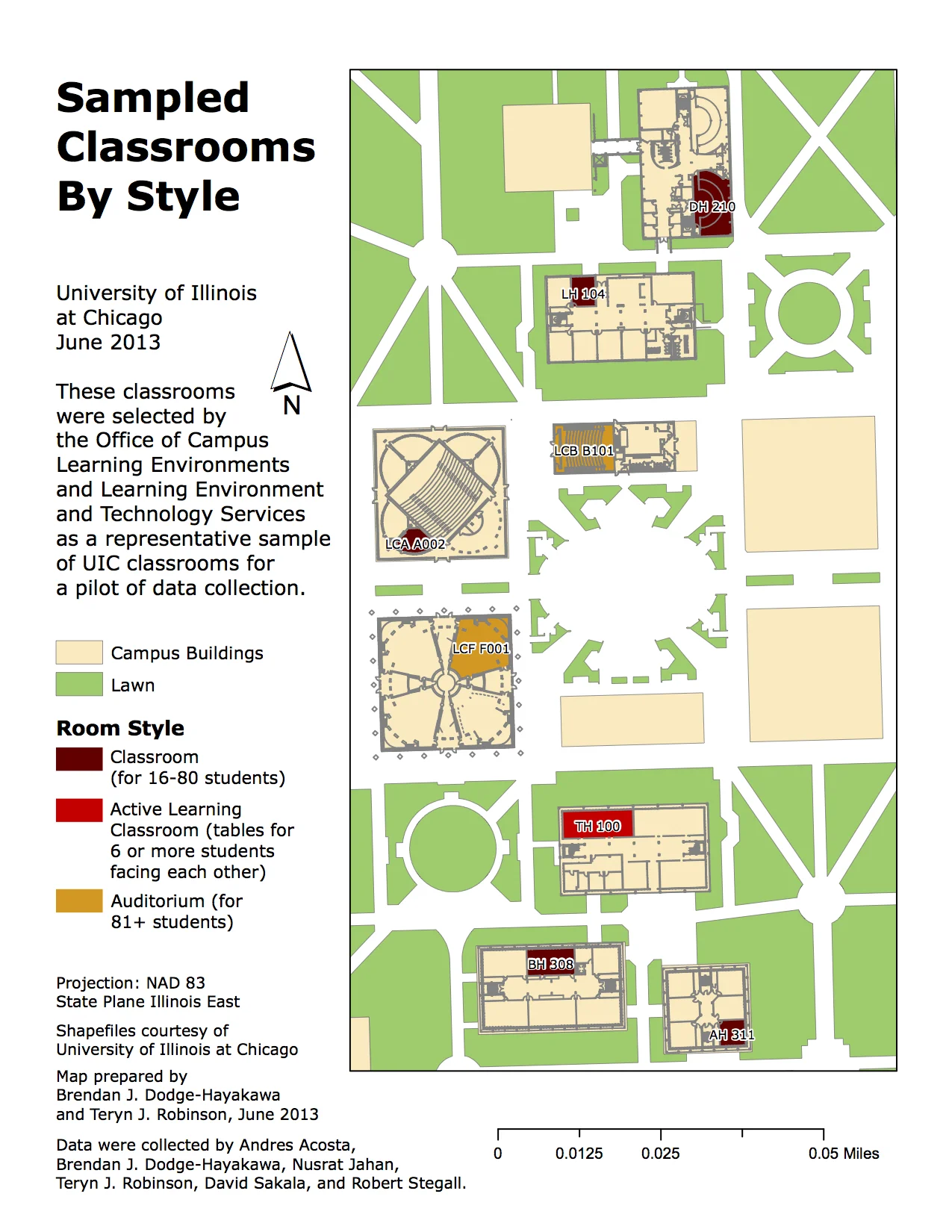
map of classroom styles for the classrooms sampled
working the pilot
Among our team of students, Brendan Dodge-Hayakawa and I were responsible for spatial analysis with ArcGIS. I prepared the maps included here, built upon the analyses he and I did together. We agreed the first map should provide context for later maps, so we chose to highlight sampled classrooms on UIC's quad.
This was my first project working with AutoCAD files in ArcGIS. The classroom layouts were adapted from CAD files, and the classrooms were created as new features, based on the line features of the classrooms from the CAD files. A portion of our pilot work focused on the amount of time it took us to collect the various data about the sampled classrooms. These data would be used to help estimate the amount of time necessary to complete the data collection for all of UIC's classrooms, providing an estimate of costs for the data collection labor.
working beyond the pilot
In addition to using GIS as a tool for analyzing and describing the data we collected, we wanted to help the university staff visualize how GIS might be a powerful tool for future uses of the data. The last two maps shown here are not based on real data.
I created the wifi service points as new features based on no real data. They serve to show a two-dimensional representation of how one point may suffice for a building and where potential redundancies could occur. A simple buffer is useful for illustrating those two possibilities.
When we were initially presented with this project, the UIC staff members for whom we did the pilot mentioned that they would be bringing in experienced outside contractors to do some additional analyses, such as classroom light and sound. Until this point, all of our GIS work was vector work. I wanted to show how raster data could be useful in some applications, so I chose their scenario of light analysis. I created point features at random in one of the classrooms and randomly assigned them values to represent light readings. The spatial analysis of these random sample light readings accounted for the readings of neighboring points when generating the raster.
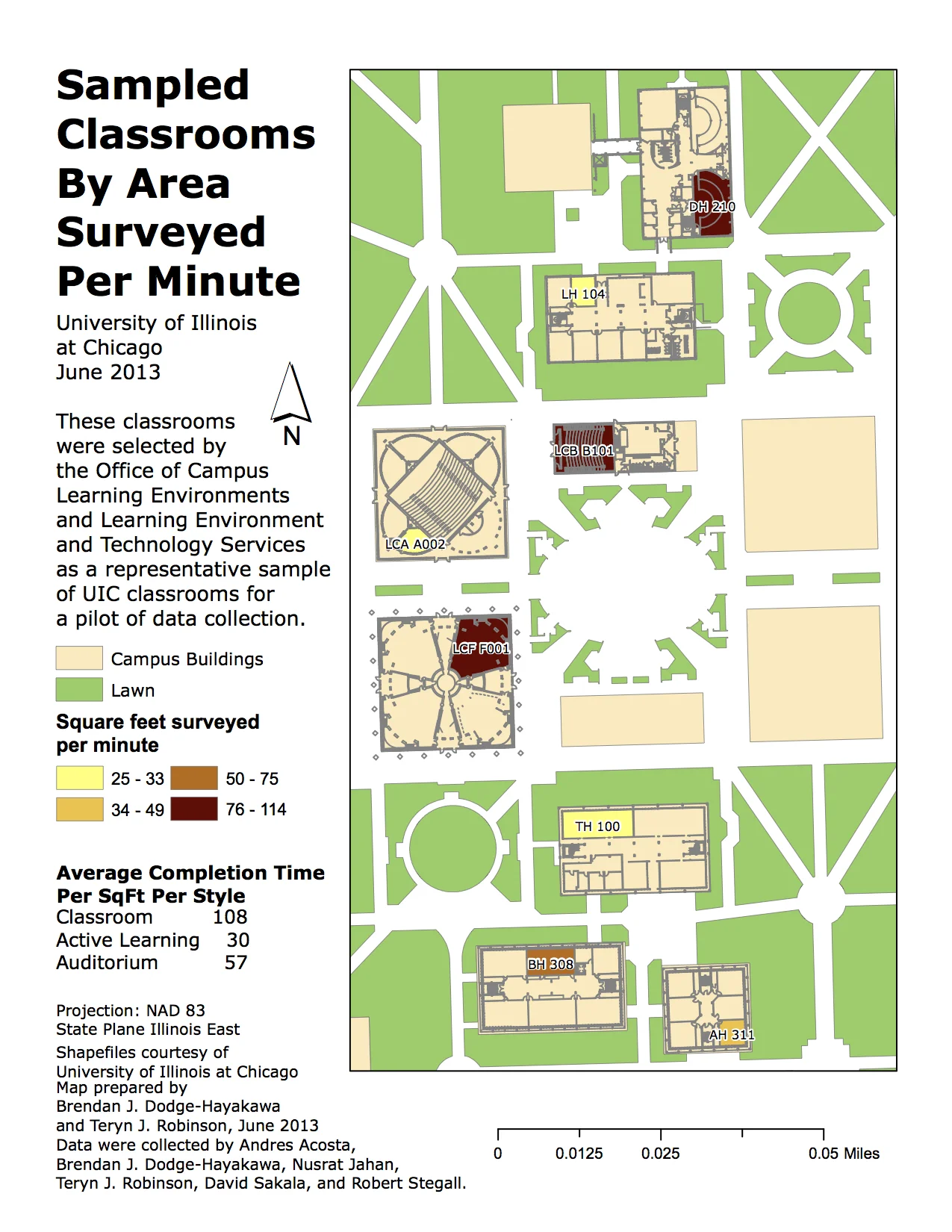
map of sampled classrooms with amount of time to complete each classroom and means for each classroom style
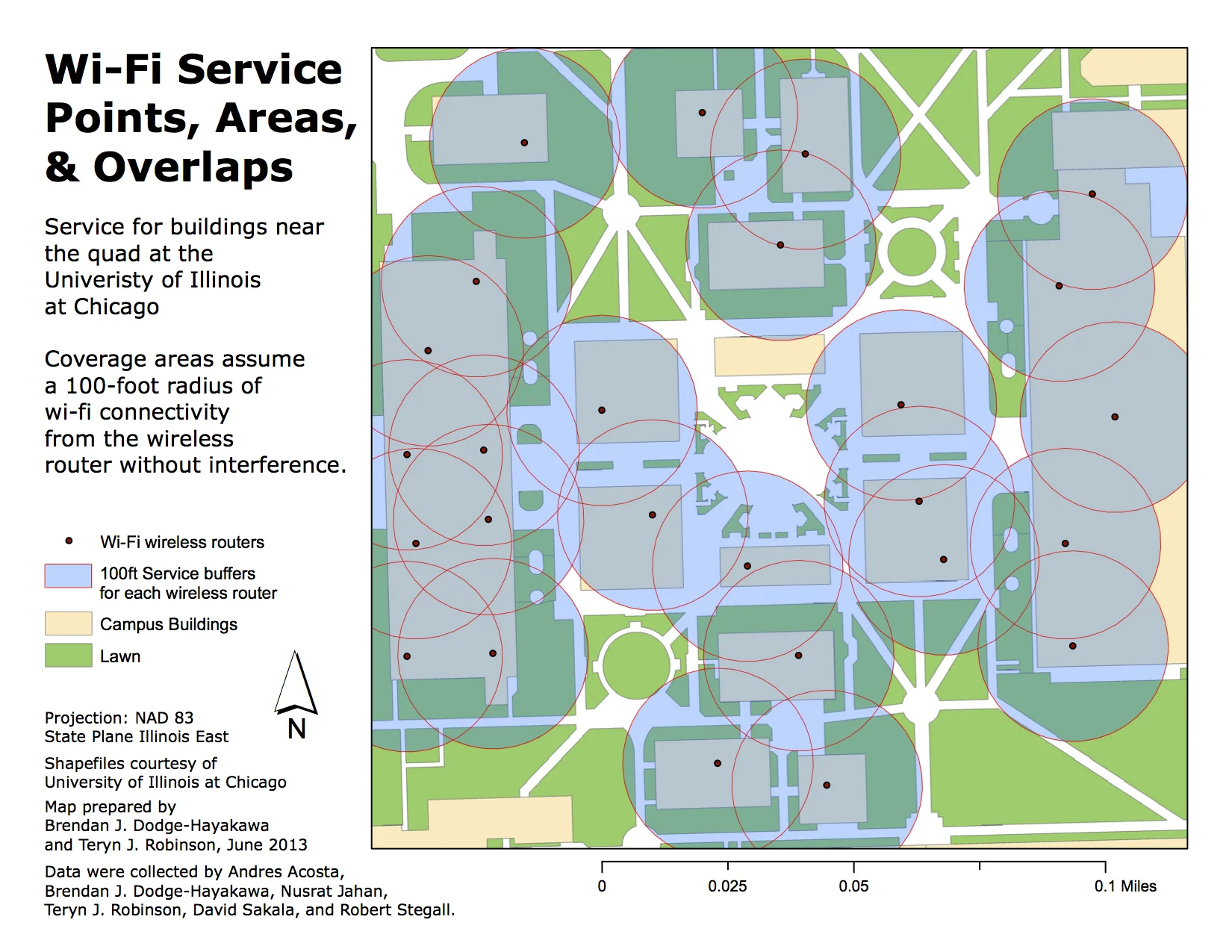
map illustrating potential buffer analyses, here with wifi hotspots
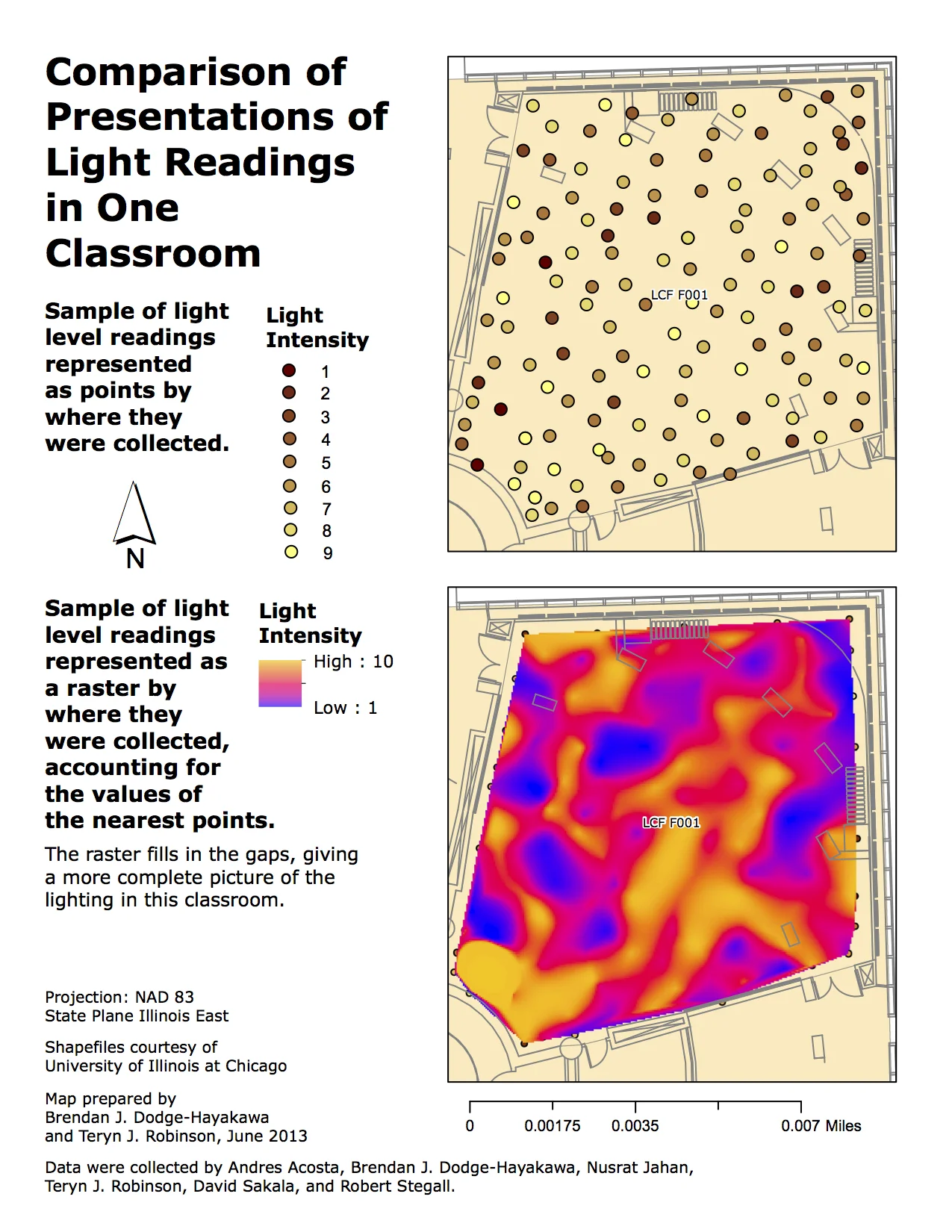
map illustrating potential uses for rasters, here examining light meter readings